Book Review: The Shadow Effect: Illuminating the Hidden Power of Your True Self, by Deepak Chopra, Debbie Ford, Marianne Williamson

 Reviewed by Nancy Martin

PART I – Deepak Chopra

 “The Shadow” is a term coined by Carl Jung, the noted follower of Sigmund Freud, for the unwelcome parts of ourselves that we hide from conscious awareness. This dark side is often explained as a judgment—what we reject in others is what we cannot accept within ourselves. Dualism is the framework, e.g. right/wrong, good/bad, win/lose, hope/resignation, etc. We don’t want to accept as ours the thoughts and behaviors that go against our value system. The more we repress our dark side, the easier it is to present a persona that radiates all “goodness” and light. The unconscious, which Freud saw as the individual’s construct, Jung envisioned as impulses and drives coming from the entire history of mankind. Therefore it is a collective unconscious, shaped by all and incorporating the shadow of all.

 By ignoring our dark side, we only intensify its power over our conscious choices. This is witnessed in violent behavior as well as in mild, socially tolerated ways. When consciousness is no longer divided, when what we see is one self in all directions, “a new self and eventually a new world can be born.” Growing beyond our self-imposed limitations of the illusions our dark side imposes, we can gain compassion for self, courage and freedom. The goal is to be empowered with our wholeness, open to expressing our passions and realizing our dreams.

What is the evidence of the collective unconscious behavior in groups? The beginning came through body-mind medicine, the discovery of ‘messenger’ molecules that show how the brain translates emotions into a chemical equivalent, affecting our organs. Studies at Stanford University established the social contagion theory through bad conditions in a prison experiment that let dark forces emerge. A class of students was divided into two groups:  guards and prisoners. The ‘guards’ began to severely mistreat the ‘prisoners,’ even though they were all considered good kids studying at a prestige university. They weren’t bad apples–they misbehaved through adopting that “us vs. them” mind-set, where people lose their individuality, becoming just faces in a crowd. If there are no consequences of one’s bad actions, the loss of individuality increases.

N. Christakis and J. Fowler from Harvard analyzed  data from the three-decade study of 5,000 people in Framingham, Mass., and found invisible connections that run through a whole society. “When one person gained weight, started smoking, or got sick, close family members and friends were 50% more likely to behave the same way.” Any behavior can be contagious, and three degrees of connection became evident: “a friend of a friend can make you prone to smoking, unhappiness or loneliness, even though you have never met this friend of a friend.”

Our impulse for separation is behind the contrast—light and dark, divine and the devil, saint and sinner. Chopra suggests life has no juice, as in electricity, unless one pole sends a current to the other. He sees the shadow as the separation impulse and the divine impulse as one that seeks unity. The new reality we seek calls for a holographic impulse, one where the whole is represented in each part, no matter how small. Resolution and freedom come from recognizing the shadow is part of our psyche and that whatever exists in it is within our power to dissolve. The shadow tries to keep you unconscious because it’s the hiding place of pain and stress.

The process for nurturing the shadow includes: “keeping secrets from yourself and others; harboring guilt and shame; making yourself and others wrong; needing someone to blame; ignoring your own weaknesses while criticizing those around you; separating yourself from others; struggling to keep evil at bay.”

Choices for diminishing the shadow’s power deal with stopping our projecting, detaching and letting go, giving up self-judgment, and rebuilding your emotional body, which he describes as “the lightness of being,” becoming more whole. It exchanges judgment for the real experience of compassion, love, and forgiveness.

A new worldview is needed—the entire universe is made of consciousness, “infinite, all-embracing, all powerful, and all knowing.” He speaks of coordination of all action: information shared with all parts of the whole in instantaneous communication, energy is perpetually reshaping but never lost, evolution continually produces more intricate forms, and consciousness expands with more complex forms.

Wholeness and healing are very closely connected—always seeking balance within your body, within your life, within your world, as change and the laws of nature progress through transformations. Letting go of the split self with all its dualities is experiencing wholeness and being able to value the dynamics of each without being a slave to any.

Transcending the shadow brings the realization that “the level of the problem is never the level of the solution.” Going beyond the conflict brings a new perspective, a broader context that opens the way to resolution. Willingness to surrender your thinking mind to meditation, switching your focus from mental chatter to perhaps your breathing or chanting a mantra. frees your potential for limitless possibilities for peace and ever expanding consciousness.

PART II – Debbie Ford

Making Peace with Ourselves, Others and the World 

A familiar picture is presented of people who pray, wish, and desire to change some vexing behavior—procrastinating, overspending, overeating, resenting .  . .while hiding their discontent with a cheery countenance. With this simmering distress often comes forgetting they ever wanted anything other than what they had.

Our egocentric self believes that some change in a stressful person or thing will bring us happiness. Looking outside the self precludes lifting the veil within to see “who we think we are and who we really want to be.” Defending the former image prevents us from discovering our true self, our wholeness. The shadow, our dark side, the part we can’t imagine has anything to do with us and don’t want anyone, especially our loved ones, to see, becomes the major obstacle to realizing our true nature of greatness, compassion and authenticity.

She recalls her inner turmoil of opposing voices when she transitioned from an awkward preadolescent into a pretty young teen—“You’re an idiot.” and “I’m better, prettier, smarter and more talented than everyone else.” Attempting to feel better led her to a sugar addiction and progressed to cigarettes, Pot, pills for uppers and downers and psychedelics.

Success at masking her true feelings and imitating the girls who seemed ‘to have it all together’ deceived herself as much as others until her world crumbled. Finally, at the age of 27 in a drug treatment center, she began to see the havoc of her battle with the dark side. Ultimate surrender in that war revealed a passion to help others on the journey through the human psyche to value their wholeness. The realization that “we possess every human characteristic and emotion, whether active or dormant, whether conscious or dormant” levels our field of reference.

The panoply of self-expression brings the gifts our wholeness manifests, making possible infinite means of well-being and peace—the freedom to truly be and extend love to our oneness. Integrating all the aspects of our journey expands the richness of our days and builds on our potential for gift giving and receiving.

Her beliefs now are that forgiveness, happening in our hearts not our heads, is the “hallway between the past and an unimaginable future; everything happens for a reason; we are always evolving and though oftentimes painful, it serves an important purpose; there is wisdom in every wound; and we are more than we ever dreamed possible.”

PART III – Marianne Williamson

Only Light Can Cast Out Darkness

 Struggling over the juxtaposition of so much tender beauty in the world—from sleeping babies and bounteous bouquets of blossoms, love on earth—to wars and inexorable suffering and destruction of living things, she acknowledges an antiforce that gets us to do its bidding because we have forgotten who we are and “thus act as we are not.”  This darkness represents not a presence but an absence of light. “And the only true light is love.”

 Separated from love, our wholeness and God, we perceive our anger as justified, blame of another is only reasonable, and attacking someone is righteous self-defense. Fear takes over and threatens to crush the soul. The antidote is to change our thinking to a higher frequency—loving unconditionally and unwaveringly, involving radical truth telling, and expanding our sense of love beyond the personal, social and political implications.

Metaphysically, through her work with Course in Miracles, she accepts “Nothing but God’s love exists and what is all-encompassing can have no opposite.” Practically, however, understanding the creative power of our thoughts and words and our propensity for separation, she sees God’s gift of the Holy Spirit, the Illuminator, as a bridge between our shadow and our light. This reminds us that the darkness is not real, and through prayer with the willingness to separate the truth from illusion, we are open to seeing others and ourselves differently.

Cultivating the sacred in our lives gives us space to stay connected to our spiritual reality, seeing how busyness can be our enemy and how communing with others in a holy space can bring balance and peace. With awareness of the ubiquitous negative thoughts, you can place yourself in the flow of gratitude, eliminating self-hatred and affirming others at the same time. “Prayer is a force; meditation harmonizes the energies of the universe; and forgiveness transforms the heart.”

Energy created in a group is a collective shadow, magnified and growing exponentially–with fear or love. The challenge is to love with a greater conviction than to the hate and fear of terrorism. The illumination of our true needs comes not from rational evidence but from a mystery for the realms of pure potentiality.

Apprehension about our shadow is easily seen and felt until we come to see that our darkness also hides our light, and “It is our light, not our darkness that most frightens us. We are powerful beyond measure.” Our consciousness and our choices expand to embrace our wholeness and the love our Source has given to us all.


President’s Letter

November 2011

What do the ipod, telephone, and internet have in common? According to Steve Jobs on a taped forum via the TV show 60 minutes on October 23, 2011, he says the common tool is the iphone.  OK, the phone, correct? Is it really far from the old landline that hung on the wall with the dial tone and manual piece, navigated by your index finger? Now this one device, called the iphone, integrates all your products and  software into that unit, thus integrating all your communications into one simple tool.

One cannot help but acknowledge how much ‘virtual’ relationships have changed the landscape of communication since the onset of the internet. The passing of Steve Jobs this month brings this to mind for me as he was the creator of the virtual relationship conduit. Because of this technology, we are able to build relationships with people whom we may never meet and shake hands with or hug. That can be viewed as  the upside of technology, while the downside is the loss of interpersonal  connection or the loss ‘to be seen by the heart,’ as Dr. Rachel Naomi Remen notes in her book “Kitchen Table Wisdom.”  To Be Seen By the Heart is the title of the chapter wherein she describes a moment in her life when she was 3 years old and she meets her dying godfather for the very first time. That moment ‘when we are seen by the heart we are seen for who we are. We are valued in our uniqueness by those who are able to see us in this way and we become able to know and value ourselves.’ When her godfather opened his eyes and saw her, he smiled at her and very softly said, ‘I’ve been waiting for you.’ He died moments later.

Our challenge for our current and future relationships is to obtain and maintain the heart connections with each other.  Our challenge as a member-driven organization is to maintain relationships and support all of us as best we can. Since we are in the virtual environment, we have to be even more diligent in connecting with each other.

To better serve you as a member of the RPA Association, we continue to improve our systems to meet your needs and improve our relationship. In the light of Steve Jobs’ contribution, I view these RPA changes in the spirit of efficiency, inclusion, expansion of services, and directly going out to meeting and addressing the needs of the uniqueness of each of our members. In addition, we have made some streamlined changes at the  Board level, but first before I introduce these to you, I want to share something from Dr. Steven Porges. He is a scientist , researcher, founder and author of the Polyvagal theory.  In a recent webinar I attended, he describes his Social Engagement System that centers on the Heart-Face Connection and the importance of voice, eye contact, and facial expressions. Taking his work and fast-forwarding it to the world of Steve Jobs and the current technology, Dr. Porges has this to say about relationships:

The phone stripped away the voice from the face.

The email stripped the word from the voice.

 While the technology will continue to speed forward, we can promote and demand the relationship coherence we expect and need to be with in partnership with each other.

We are trained as Resonance Repatterners in relationship coherence. I invite you to have that with each other and to have that with the RPA. Mutual give and take in this Association is dependent on the growth and stability of this Association. We have so much room for volunteering and new ideas. Please contact me or any of the Board members or Chairs and offer your support. We look forward to working with you!

We are very excited to share these updated and revised opportunities to maintain your CEU’s and share about the new Board structure!

Here are some of the wonderful changes we have made this year:

RPA Board Structure change:

The Board structure has changed from 12 seats on the Board to a 5-member Executive Board. We had our first meeting in October, and I am just thrilled with the Board support in moving in this direction. The Executive Board now consists of: Laura Frisbie, Secretary; Paula Caplan; Joie Jacobsen; Don Giberson; and myself. Josephine Rovari is present during meetings as the RPA Admin Assistant. All the other Board members have moved to Advisory Board chairs of their respective committees.

Continuing Education Changes:

An expanded list of modalities outside of Resonance Repatterning® for continuing education.

This year the Board backdated the timeframe for when non-Resonance Repatterning workshops and events could cover members for CEU’s. We can now go back to July 2010 for programs attended, and if the program is on the list of approved workshops,  you can get CEU credit for attendance. Follow the link for the approved modalities list and also to see how you can log your attendance on your MY Account page. Any workshop or program you attend, you will need to provide a copy to the RPA for record-keeping with the approved number of CEU’s stated on your certificate of attendance by your workshop host. Click here to see the expanded list of approved courses:

http://www.hramembers.org/BoardRoom/Policies/approvedmodalities.asp

Then to update your account  and record of CEU’s, go to the My Account page at the member’s site. You will need your password to sign in.

http://www.hramembers.org/Membership/MyAcctCEU.asp

These are for non-Resonance Repatterning Institute classes earned.  You will need to record the number of CEU’s designated and this needs to show up on your certificate of attendance. Instructions are located there on how to record online and where to mail your hard copy of record of attendance or, you can scan your record of attendance showing CEU’s to Josephine Rovari, the RPA Administrative Assistant. The address is provided on the website in this section.

We are very excited about these additions and how our operations are becoming streamlined and coordinated for efficient use of time and efficient ways to stay certified.

Blessings to each of you~

Karen Kent

President, RPA

Relationship as a Sacred Journey

Relationships are very intriguing to me. You are in relationship with everyone, from your banker to your lover and everyone in between. How you experience relationships can be uplifting or debilitating depending on how you are in the relationship. Every interaction counts.
Have you ever noticed that the experience you have in an interaction depends on how you approach the person? I have done many conversation experiments, and what I have come to know is the more loving, friendly, and compassionate I am, the more the person I am talking with is that way with me. I have observed this especially when talking to someone, for example, at the phone company when I call in asking for clarity or resolution regarding my bill. Try it next time and notice the difference!
Another experiment I did, many years ago, was with my father. It seemed to me that when he called me,  he was reporting how things were going with him and his new family. He would tell me all the things I wished I had done with him when I was young, but since we did not live together, my siblings and I did not get to do many activities. I found myself getting envious of what they were getting that I did not. What was missing for me in his calls was acknowledgment that I still mattered in his life and that I meant a lot to him. So, I started acknowledging him for being such a great father to his other three children and how fortunate they were to get to do all the things they were doing and to have him as a Dad. After just two phone calls, he started asking about me and my life and told me how important I was to him. He also acknowledged me for how much of a difference I was making in the lives of my clients. This was something he had not done before. So the very thing I thought was missing I gave him, and in the very giving of it, I experienced acknowledgement and seemingly out of nowhere, he gave to me the very thing I was previously missing. It was quite remarkable. The switch was very dramatic. So, if there are qualities you are lacking in relationship with others, bring that quality to them or the situation and watch how you are actually experiencing the very quality you previously thought was missing.
There are so many things I have learned over the last few years especially when it comes to relating with men. I would like to honor Allison Armstrong, the developer of the “Celebrating Men, Satisfying Women®” series, http://www.understandmen.com. She has spent over thirty years studying men. I would like to share some of the things that have made a difference when I speak with men that I have learned from Allison’s inquiry.
Allison has come to know that men are wired to provide, so I let men know what it is that they would be providing for me if they helped me, and they seem to jump at the opportunity. Since men love to make women happy, I might say to my beloved partner Bernie, “It would really make me happy if you would call me before you left your house to come over, so I know when you might be here. It would provide me more time to get ready to see you after I get caught up on my emails.” Even when men I do not know help me, I make it a habit to tell them what they provided for me. Their chest puffs up, knowing they have just made a difference;  they love it!

According to Allison, men are also wired to protect women. For example, I might say to Bernie while he is driving us somewhere, “I would feel much safer if there were more distance between our car and the car in front of us.” The interaction is not making him wrong for driving so close, rather, it is about proving safety for me. He naturally slowed down and I made sure I appreciated him by saying, “Thank you, I feel much safer now.” It is important as women that we let men provide safety for us and then appreciate them for it.
I have learned so much about my partner Bernie, just from listening to him. Asking him a question, then being quiet, gives him the time he needs to disclose what he chooses. Over time, he reveals more and more of who is and what he is up to, just in his speaking. Being present for another and listening is such a wonderful gift we can give each other.
I have also learned over the years to ask a man what he thinks rather than how he feels. You would be surprised how much information you get. You can actually learn what means a lot to men, what men value and what men hold dear and near just by listening. Men feel acknowledged and respected when they are listened to and men love respect and acknowledgement!
Allison also talks about how important men’s opinions are to them. She states that men’s opinions are to them, as women’s feelings are to women. So, just by asking their opinion, you can hear their inner longings, goals and what they are up to. You can also hear their sincere desire to help and make a difference in your life. Start really listening and notice the difference!

I like to look at intimate relationships as a sacred journey. We can use everything that ‘comes up’ for us and triggers us as an opportunity to heal. For those of us who are privileged to do Resonance Repatterning®, we can find and clear, or inquire and resolve, what happened in the past that is unresolved that is underneath the current upset. In this way, your intimate relationship can be like a journey, a sacred journey into your greatness, if you will. If you are in an intimate relationship, I encourage you to change your perspective and notice how much more freedom and love you share. Those of you who are not in an intimate relationship, the more you clear what is still unresolved from your past relationships, the more you will be open to the qualities you want to attract in a partner. Those of you who do not do the Resonance Repatterning® process, I would encourage you to find a practitioner in your area or have a phone session with a certified practitioner that you really connect with. The sessions are very profound. You can find one at: http://www.repatterning.org.

Relationships can be more uplifting if you are part of the solution, rather than part of the problem. If you go into the interaction with this intention, you will always get a different response, and your relationship with whomever will be a sacred journey– a source of personal transformation, joy and love.

Lovingly submitted,

Victoria Benoit, M.C.

Victoria has been a Certified Resonance Repatterning® Practitioner since 1994 and Teacher for fifteen years in Phoenix, AZ. In 1996 she opened the “Center for Extraordinary Outcomes”. As a Licensed Professional Counselor, she has used Resonance Repatterning® and five other methods, rather than psychotherapy, with her clients for the past 16 years. She is available for in-person and phone sessions for individuals, couples, groups, families and businesses.

Work Phone:  602-864-7662

.

On Changing Your Name

When someone asks you, “Who are you?”  You say,

Name Tag
Changing Your Name

“My name is _____.”  There is energy to your name, which deeply effects who you are.   If you don’t believe it, imagine how you would feel about yourself if your name was “Pickle”, “Beth”, or “Renaldo’?   Would Marilyn Monroe have been considered as sensuous and sexy with the name Norma Jeane Mortenson?  Indra Nooyi is CEO and Chairman of PepsiCo and is often identified as the most powerful woman of the world.  How could you not take someone seriously with a name like Indra, meaning “Lord of the Heaven”!

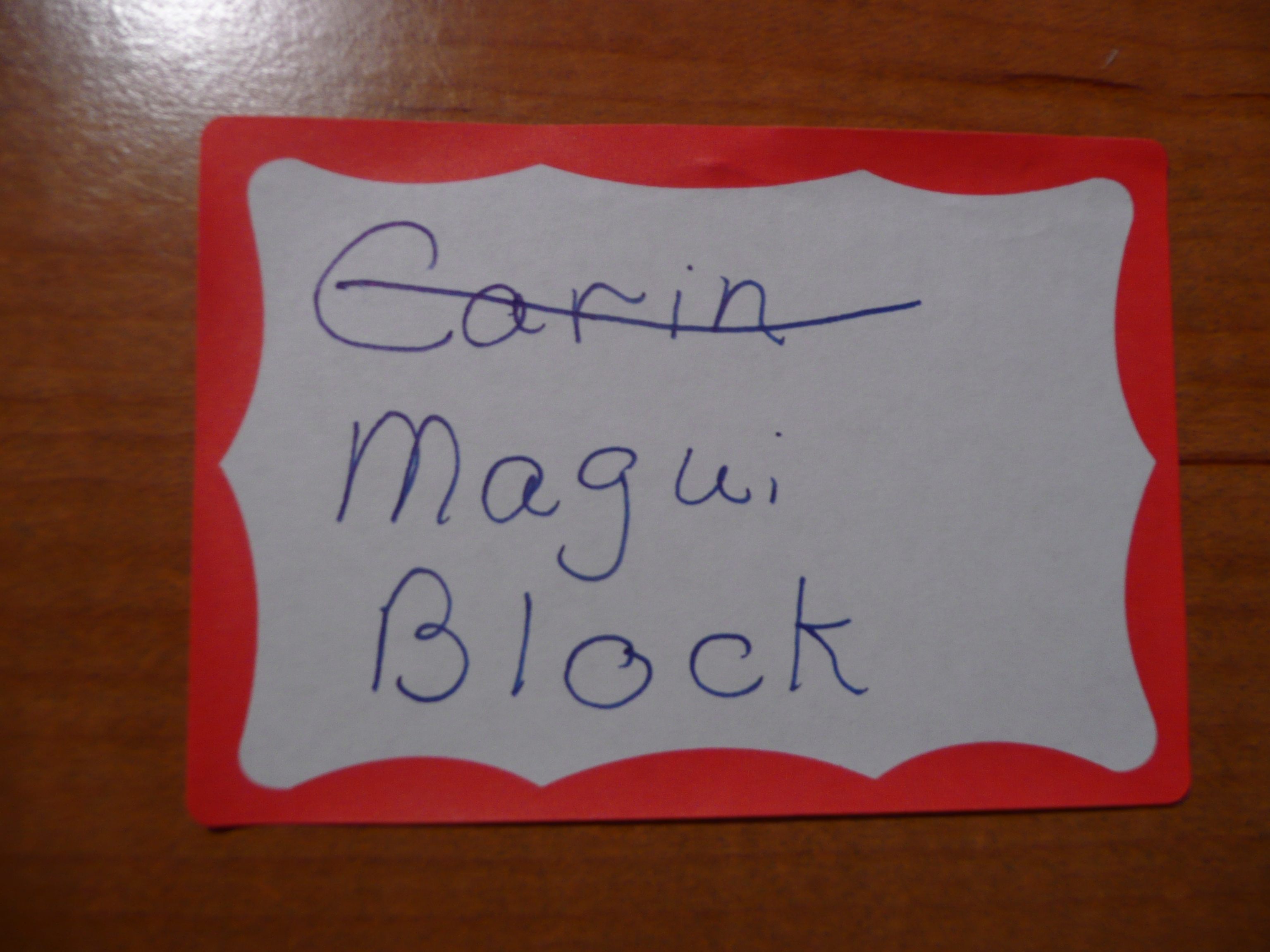
Here is a story of what happened when Resonance Repatterning® Practitioner and teacher Carin Block decided to change her name to Magui Block.

Sally:  How is it that you decided to change your name?

My mother gave me a birthday gift of a numerology session.  The numerologist stated that my name did not fit me.   But I could not figure out what to change my name to.  Shortly after that session, I went to a supermarket and my money was stolen.  I saw it happen and I could not do anything about it.

I clearly saw that the name “Carin Block” resonated with being a victim—that that name attracts bad things. I had worked those non-coherent patterns with Resonance Repatterning and constellations, and I saw by listening to my name many times every day that “Carin” was creating a negative impact.  I loved that name, I was used to that name, and everybody knew me as Carin Block. I had a career with that name. How could I change it?

It was a jump, an opportunity to leave behind old patterns, so I did it. I was afraid and at the same time my heart felt lighter.

I decided to use Magui, that is the nickname of Margarita, my second name.
“Magui” is like magic and I want to do magical tools that heal with grace. It is aligned with my vision.

Sally:  How has your life changed since your name has changed?

Magui:  Before I changed my name, I was stuck in my writing and after I changed my name, I wrote a new book and a new workshop.  After I changed my name, I found out about a government agency that supports small business, to help businesses grow.  I am now in training to create my business.  I am required to give a frank look at how to run a business.  For example, I am learning how to handle employees.  I have created a brand name—my name is my brand name.  I am creating a new logo. I got in contact with my vision as a business. I am learning how to teach and create in a different way.  I do not want to repeat the same mistakes. I want to make it better and I feel different, stronger.

Sally:  How did Resonance Repatterning help you in your process of changing your name?

Magui:  Resonance Repatterning has helped me all through the process of changing my name: making the “right” choices, managing the fear, leaving the old behind and all that triggers a big change like this. It is to leave an “old” way of being and welcoming a new one. Resonance Repatterning helps to do just that: quantum leaps.


Interview by Sally Herr

How Anxiety Causes Relationship Problems

For the anxious person, relationships can be a living hell.  Far from the oasis of warm support and connection most of us associate with relationships, the anxious person is caught in a vicious cycle of stress responses that create yet more anxiousness.

An anxious person typically has the most difficulty in romantic relationships, followed by friendships and work relationships. Oddly, the research doesn’t mention family relationships.

Resonance Repatterning for Anxiety
Anxiety Causes Relationship Problems

I worked with one woman whose relationship with her romantic partner was wonderful. She came from an intensely religious family and as a gay woman she felt insecure and rejected.  Told she would burn in hell by her (otherwise loving) family, she needed friendships to fill the role of family for her.

However, when there were changes in her friendships she found herself panicking.  She couldn’t trust the bond of friendship to weather the natural disruptions of life such as someone moving or even being very busy. She couldn’t trust her close friendships to continue to be “like family”–that they wouldn’t abandon her–because on a deep level, her family had abandoned her.

See the catch 22?  For her, family, intimacy, bonding, love–all mean being abandoned at the primal, core level of accepting who she is as a gay woman.  When her friends needed space to work out their lives, she became needy and demanding, “making it all about me,” as she put it.

Relationship anxiety is an internal battleground where the desperate need for reassurance and security are the very things that threaten the relationship.

The anxious person is caught in a catch 22.  The obvious need is to trust—but at the same time when trust is most needed she absolutely must not collapse into trusting her overwhelming sensations of anxiety.

“I am driving my partner crazy with my drama and neediness and I can’t stop!  My anxiety is pushing him away… and that just makes me even more anxious,” is a typical complaint.

In 2004 the Anxiety Disorders Association of America (ADAA) conducted a survey of GAD (generalized anxiety disorder) sufferers on the effect their anxiety on their romantic partner relationships.

Seventy percent of GAD sufferers believe their relationship anxiety has a negative effect on their relationships. Compared to non-anxious partners in romantic relationships GAD sufferers were:

  • Half as likely to perceive themselves as being in a “healthy, supportive” relationship.
  • Twice as likely to experience relationship problems in communication, social activities, arguments, and sexuality.
  • Three times more likely to avoid sexual intimacy.
  • Seventy-five percent believed their anxiety impaired their ability to participate in normal activities with their partner.

    Natural Remedies for Anxiety
    Natural Remedies for Anxiety

Relationship anxiety often creates mental state of suspiciousness and worry about their partners’ love, care, or faithfulness.

Becoming aware of their anxiety only serves to make them suspicious of their own thoughts and feelings.  The inverse holds true as well: Suspicions about their own thoughts creates anxiety.  The perception is there nothing to trust.  Any evidence of love and care on the part of the other gets lost in the fear and confusion.

Persistent needs of reassurance, dramatic confrontations and destructive impulses create even more stress in the relationship. Intolerable mental-emotional states create an urgent need for relief  (but make for bad decision making.) There is a downward spiral.

Anxious people blame themselves for not overcoming feelings of fear and panic and for the negative effects it has on their relationships.  Despair takes hold.  Traditional therapy leaves them “knowing better….but not being better.”

Adult Separation Anxiety

What we see as a pattern underneath the anxious person is someone who wants and needs (but is unable to receive) the closeness and security of relationship.

What we see in the relationship patterns of an anxious person is someone who desperately needs assistance with healing.

What we see in the unhealed stress responses requires much more, or something much different, than what either medication or thought-out rational explanations or problem-solving can even begin to provide.

What I see is a great need for Resonance Repatterning.

“The place God calls you to is the place where your deep gladness and the world’s deep hunger meet.”  Frederick Buechner

Laura Frisbie

http://www.beat-depression-naturally.com 

Resonance Repatterning Practitioner specializing in abandonment and natural anxiety treatment

Resonance Practitioners Association Executive Board, Journal Committee, Skills Development Facilitator

Book Club Discussion Part 1 of THE BOND: “The Superorganism”

In Part 1 of “The Bond, Connecting Through The Space Between Us” – Lynne McTaggart sets out to demonstrate how we exist in relationship to each other via our bonds as well as with the universe itself. Beginning with an account of the scientific explorations on the observer affect pursued by Wheeler and others, Lynne McTaggart challenges our thinking about where we end and the universe begins.  This is indeed a great struggle for advanced meditators who are able to shift their state of awareness from oneness (I am) to interconnectedness (we are) and back again to the state of ‘I am.’   “The Bond” makes the case for expanding our ability to think from the perspective of a unified ‘we’ versus a solitary ‘I.’

This section of the book also opens an interesting discussion on the topic of genetics and how genetics alone does not shape our life or destiny.  Rather, it is our positive or negative environments as much as anything else that determine who we are.

Lynne McTaggart’s account of the theories of the Russian scientist Alexander Chizhoevosky in 1921 was most fascinating.  He had proposed that many of the world’s upheavals in history were the result of solar activity and solar flares.  At the time his theories were not well accepted as political regimes preferred to think of a revolution as the result of the people rising up against the status quo.   The poor man was sent to the northern reaches of Russia, where he could not expand his theories. However, 30 years later, his work was revisited by scientists who felt he was quite possibly right after all. It turns out that there is a correlation between the sun’s activity and many social phenomenon.  We are linked to solar weather and all kinds of geo-magnetic activity of the solar system manifesting as increases in crime, heart attacks, car accidents, mental illness symptoms flaring up, and swings in the stock market to name a few.

In the final section of Part 1 Lynne McTaggart discusses our shared circuitry and how the emotions of another may be mirrored in ourselves via an empathic response.  We can relate to others in distress because we put ourselves in their shoes and literally feel their pain as if it were ours.  Repatterners, who have felt the physical pain of others, will find this section fascinating and informative.

Her conclusion is that we are hardwired to connect with others to survive and be our true selves.  We are born to play as a team.  Our tendency toward competition is self-destructive, and harms us more than we realize.  We have the predisposition to be collaborative with no inter-conflict and in that state for all of us to flourish.

Submitted by Carolyn Winter

Past president and current RPA Volunteer

 BOOK CLUB DISCUSSION: 

What Are Your Thoughts? – Your comments on this post in general are welcomed or on any of the book club questions below.  To get to the comment box, be sure you are on the page for this post by clicking the title above.  That will take you to the page with a comment box and where you may share this article on your Facebook/Twitter or other social media network.
Book Club Questions:

What has been your experience of ‘shared circuitry’ in your life?

How has community life changed for you in your lifetime?

What is your best experience of community or shared circuitry?

In what ways have you repatterned a bond of belonging?

Related Links: General Book Review | Part I “The Superorganism” (this Post)| Part 2 & 3 Coming this November

Book Trailer Video 

Book Review – The Bond: Connecting Through the Space Between Us by Lynne McTaggart

Lynne McTaggart is the author of several books including “What Doctors Don’t Tell You,” “The Field – The Quest for the Secret Force of the Universe” and “The Intention Experiment.”  You may remember Lynne McTaggart as one of our virtual conference guest speakers in 2008.   For anyone wanting to understand more of the science behind why repatterning works, any of these books are highly recommended.  In her newest book “The Bond,” journalist Lynne McTaggart tackles her topic by sharing the explorations of science that support her proposition that we are more than individuals but owe our identity and being to our connection with the many bonds in our life and ultimately the universe itself.  More than that, it is the space in between these bonds where the connections are forged.  As a first-rate storyteller, McTaggart recounts the scientific trails that lead scientists to particular conclusions with the tone of a good mystery cliff hanger quickly drawing the reader into each chapter.  It soon doesn’t feel like a technical book at all as you race to read the next chapter to find out where the next piece of evidence exists.

This book is about the innate resonance or energy that is available to us through our entrainment with each other, our groups, our community, our culture, the world. In repatterning language, it is the entrainment frequencies that may have weakened for many of us depending on where we live, or our cultural ties or group. In western society McTaggart makes the point that the pull towards individualization, me first, and qualities of greed, dishonesty, and competition have weakened our bond with each other and with the world. According to the studies outlined by Mctaggart we suffer with greater mental health issues, physical health, our happiness and longevity.  We may die having the most money or stuff or both, and think we are really the winners when, in fact, we have lost more than we know.  Lynne McTaggart successfully argues how it can be much different.

Throughout “The Bond,” McTaggart outlines many rich examples of people, groups and societies with a much different world view that illuminates our bond from nature itself to each other and our group.  Her purpose in writing the book is ‘to prove that we are living an outdated set of rules and to demonstrate how easy it is to live in wholeness.’

After reading this book and the many stunning examples, you too will conclude that Lynne McTaggart has accomplished her intention.

Resonance Repatterning professionals may enjoy many parts of the book that support our understanding of some of the repatternings learned in the “Healing the Family Systems” repatternings by Magui (formerly Carin) Block as well as her many references to resonance, coherence and patterns.  It may help you to broaden your perspective in some of these repatternings.

For everyone who has lived in an active community, this book will help you to understand the value of your connection there and to your life.   Lynne McTaggert’s questioning style allows the reader to take each chapter and reflect on its meaning in their own life experiences.

I highly recommend “The Bond” and invite a book club type discussion over the months ahead using this blog publication and these posts. There is a post (or will be) for each of the 3 sections of “The Bond” where you may comment or ask questions and share opinions with everyone reading along with this book.

Carolyn Winter 

RPA Volunteer

Practical Advice

PRACTICAL ADVICE is a regularly appearing column in the RPA Journal. Elizabeth Tobin, JD; Certified Resonance Repatterning® Practitioner answers your questions about creating a thriving Resonance Repatterning practice. If you have a question that you would like answered or if you would like to share your views about any of the topics discussed here, we welcome your comments.

Q: Given that Resonance Repatterning is an empowering process for positive change that can be used on any problem – physical, mental, emotional and spiritual–  should I really develop a “target market?”

A: The short answer is, “Yes!” There’s an old adage that says if your market is everyone, then your market is really no one. This means that if you cast too wide a net in terms of who you want to attract as a client then it’s difficult to connect with people on a personal level.
Marketing experts agree that when you are writing sales materials — whether it’s emails, on-line sales pages, flyers, print ads, radio ads, etc. – the most effective approach is to write as if you are speaking to only one person. If you have identified your target market and know what they want and need it will be easier for you to develop effective outreach material.

In this information age, people get bombarded with input so they filter it. In just a few seconds they’ve already decided what’s relevant and what’s not.

You need to get people’s attention, then you need to hold their attention long enough to let them know how you can help. The more specific your message the more likely it will get filtered in to the people whom you most want to reach. That is, the people who are really interested in what you have to offer. If your message is too general it’s more likely to get filtered out – by everyone.

The way to get people’s attention is to be very specific and to speak their language. For example, I am currently offering a 12 session series called “Transforming Money Archetypes and Karmic Contracts” and I’ve written specific Repatternings for the different archetypes and karmas. My target audience is people on a spiritual path who are tuned into the evolution of consciousness and the great cosmic shift that is happening. If I was marketing these same Repatternings to business clients I would use very different language. I wouldn’t talk about archetypes and karma.  Instead, I might say “Success Profile,” or “Money Type.”

When choosing your target market, it may help to keep in mind these words I once overheard from a fortune teller, “People have 3 areas of concern – health, relationships, and money. If you stick to these 3 areas you’re bound to hit on something that’s relevant to them.” I would add a fourth item: having a sense of purpose and fulfillment.

There’s another old saying that we teach what we most need to learn.

Through the principle of sympathetic resonance you’ll likely attract clients who mirror your issues, so why not focus on the one area of your life that you’d most like to change? For example, when I first started my Resonance Repatterning practice back in 2001, I was unemployed and needed my practice to start earning money from the get go. Because money was an issue for me, the first thing I did was a series called “100 Days of Wealth.” As you can see from my two examples, I’ve been in practice 10 years and I’m still offering Repatternings on the same topic as when I started out.

Here’s another way to decide on your specific niche: Consumers buy from people they know, like and trust. Telling your own success story about how you changed your life with Resonance Repatterning is a great way for people to get to know you. That you’ve been where they are now let’s them know that you understand their pain and you have a solution to get through that pain. By focusing on your own area of greatest transformation you can offer similarly situated people hope. In addition, you’ll have no trouble speaking from your heart and using language that they can connect with. What’s more, your personal experience, knowledge and insight make you an expert on the topic.

This brings us to your Unique Selling Proposition (USP). Identifying your target market ties into what marketers call your USP. Your USP is what makes you stand out in your field.

Once you’ve identified your target market you’ll have more clarity on why you’re the best practitioner for this market.

Your USP lets people know what they can get from you that they can’t get anywhere else. Why should someone choose you over other practitioners? Your unique selling proposition may include the number of years you’ve been practicing as a professional, certifications that you’ve earned, the life experience you’ve gained in overcoming specific hurdles, awards that you’ve won, etc.

Your target market and your USP are integral to your mission and vision for your practice. Think of them as intentions that you set for your business. Having a clear intention can serve as a guide to discern whether a particular task, project or joint venture fits into your business model. Knowing who you are, what you are offering, and to whom you want to offer it brings clarity and power to your marketing activities and your practice as a whole. And as we know from Resonance Repatterning resonating with your intentions is the key to manifesting them. Resonating with your target market and your unique selling proposition is the key to manifesting your thriving practice!

Elizabeth Tobin, JD is a Certified Resonance Repatterning® Practitioner has been earning her livelihood through her full-time Resonance Repatterning practice since 2001. Geographically based in Boston, MA, Elizabeth serves an international clientele with individual telephone and skype sessions, global distance healing proxy groups and live workshops. Visit her website at http://LizTobin.com

CERTIFICATION CORNER

The “Certification Corner” is a regularly appearing column in the RPA Journal and is written by the members of the Certification Board, Meryl Chodosh-Weiss, Shirley Lanyi, Paula Caplan and Mary Cameris. Each issue focuses on aspects of the Resonance Repatterning Certification Process. If you have a question that you would like to be answered in the RPA Journal, you can email Meryl at meryl@beyourbliss.info.

Please know that we all have volunteered to serve on the Board, and that our objective is to help make each Student Practitioner’s Certification journey as harmonious as possible. If you are having any problems or concerns during your Certification journey, please contact us either by calling 1-800-685-2811, option #3, or by writing us at Certification@RPAMembers.org.

We are here to support you and troubleshoot any unusual situation you may be facing. We need to be made aware of problems in order to rectify them and ensure that future Student Practitioners do not have similar experiences.

We were delighted to see that so many Student Practitioners responded to the “Grace Period” offered for all Student Practitioners whose membership and dues were more than one year past their due date. Welcome back!

The “Grace Period” was over as of July 1, but if you are a Student Practitioner going through your Certification process and have let your dues lapse, click on the following to get guidance on how to reinstate your status:

http://www.hramembers.org/BoardRoom/Policies/LapsedStudentPractitionerPolicy.htm

Practitioner Skills Development classes will be held September 26-27, in Scottsddale, AZ, with Ardis Osborn and November 5-6, 2011, in New York, NY, with Meryl Chodosh-Weiss. You can contact Ardis at ozardis@cox.net, 480-481-9023 and  Meryl at meryl@beyourbliss.info  212-628-8260, for more information.

Our next Certification Board meetings will be held  September 19th, October 17th and on November 14th, 2011.

Our next “Student Practitioners Conference Call,” is scheduled for November 14, 2011, at 7 pm Eastern Time. The conference call is to support you, whether you are a student learning Resonance Repatterning, or you are going through your Certification journey. All questions and concerns are addressed during the teleconference call, and a wonderful Repatterning is done at the end. You can register for the call by clicking on the following site:

http://rpamembers.org/Certification/TeleconferenceCallSignUp.asp

We hope you are enjoying your summer. This is the time of the Fire Element. Fire is our masculine element, its aspects being creativity, change, passion, motivation, willpower, drive and sensuality. May whatever you are experiencing during this time be productive, joyful and successful. Have a wonderful summer!

Mary Cameris, Meryl Chodosh-Weiss, Shirley Lanyi, Paula Caplan

Book Review – The Laws of Spirit – by Dan Millman

  “We can’t teach people anything; we can only help them discover it within themselves.”

            Galileo Galilei – Preface 1995

    Dan Millman states: “All journeys are true, but not all are factual.” We           find the laws on the winding paths of life within our intuitive wisdom and     without in the natural world.

 This is an adventure story, an encounter in the wilderness of northern California between the author and a mysterious woman, a mountain sage who offered to share with him her secrets of alchemy. Her secrets were not of turning lead into gold but of transmuting one’s fears, confusion, concerns and difficulties that arise into “the gold of freedom and clarity, serenity and joy” in the laws of Spirit. She explained she had found Spirit in all religions and its laws functioning throughout the universe, as do the mechanics of the universe.  Following these laws leads to prosperity and fulfillment—peace in the light of higher understanding; resistance leads to challenging consequences.

The Law of Balance is first, reminding us we can overdo and underdo on all levels of our being. Her examples are experiential, such as imagining the feeling of calm the egret experiences standing on one leg at the edge of a pond. We learn to discern the difference between ‘normal,’ which could be high tension, and what is true balance and inner peace. The way to find that serene center is through doing and becoming more aware of the imbalances of living your life that need balancing.

The Law of Choices allows us to reclaim our power—choosing our response to circumstances in life and taking action to follow through with it. The sage’s declaration that all choices serve in their own way is a comforting thought, however it feels in the process.

The Law of Process addresses the steps and awareness involved in bringing change, achieving a goal, as well as honoring the completion of each step of preparation toward what has special meaning to us.

The Law of Presence is exemplified in Margaret Bonnano’s quote, “It’s only possible to live happily ever after on a moment to moment basis.” Dealing with what is in front of you is where your body is in the here and now.

The Law of Compassion is defined as “the recognition that we are each doing the best we can within the limits of our current beliefs and capacities.” This freeing thought precludes our judgment of others when we realize Carl Jung’s adage that we reject in others what we cannot accept within ourselves. Acknowledging such tendencies within us brings our shadow side to the light, where compassion and healing can benefit all. It starts with forgiving ourselves. When faced with violence and human cruelty each of us can decide what kind of energy—love or hate—that we want to project into our world. We can learn to see all people as teachers.

The Law of Faith is about trusting in Spirit, universal love and wisdom working through us all. The sage speaks of God as a feeling of wonder and mystery rather than belief and accepts whatever happens can serve a higher purpose for our well-being regardless of how it appears. Awareness of your faith comes from listening to the intuitive wisdom of your heart, not from books, teachers, scientists and psychics. So often we seek outside us for what is within from our birth. External influences can guide you to your internal treasure. Your path may present obstacles, and your faith brings you the willingness to risk, make mistakes and move forward in the process of life.

The Law of Expectation expands our reality. Imagination, assumptions and beliefs at the deepest level determine your experience. Blocks to the realization of what we want come up as doubts in the possibility of achieving it. By expressing aloud all the reservations involved and reassessing can clear the mind’s energy. The perception and focus shifts so that negativity doesn’t hold you back. Our limitations are only in our beliefs in problems; beliefs in solutions change our life and our world.

The Law of Integrity is described as living our truth, our authentic interior reality expressed by our example, not only our words, for our own as well as others’ awareness. Completeness and unity are inferred in being yourself and knowing that is ‘enough’ even with our vulnerabilities.

The Law of Action is demonstrated beyond the thought and into our behavior, the doing that leads to understanding and moving into life. The sage delivers the message: “It’s better to do what is best than not to do it and have a good excuse.” Still, options require consideration that nonaction may be best in certain circumstances. Key is turning to your heart’s wisdom and being aware of your tendencies of impulsivity or inertia.

The Law of Cycles speaks to us of nature’s patterns in time and space. As Kahlil Gibran wrote, “In every winter’s heart lies a quivering spring, and behind the veil of each night waits a smiling dawn.” Change is life, and we often cling to the familiar, comforted in the assumption of control and order. The lessons from nature, e.g. seeds produce only their own kind, you reap what you sow, and cycles end before another begins, enhance our days and our own evolution, a ripening process.

The Law of Surrender points to acceptance of a higher will that involves receiving what is in the present, including your body, mind, and spirit and your life without resistance. Belief in the wisdom of your heart leads to spiritual growth and greater consciousness. “Learn to wish that everything should come to pass exactly as it does.” was the instruction of Epictetus, the ancient Greek philosopher, to his students. By relaxing the body surrenders to the moment versus rigidly holding to what ‘should’ happen. With practice, we can perceive all we behold as Spirit and that life is a mystery beyond our comprehension.

The Law of Unity awareness requires a shift in perception on a higher plane—coming to realize that we re not separate beings on an earth of infinite diversity but rather One Being, One Consciousness. The paradox depends on seeing both perspectives on the state of our awareness—the individual entities vs. parts of the whole. The choice becomes ours. The concept begins as incredulous to our comprehension. The sage, however, suggests being open to feeling it—a sense of deep connection to your presence at that moment, bringing pure peace and joy. How would your life, your reality change by embracing a vision of humanity as One? The oneness dissolves the wounding and heals the wounded with compassion for all creation.

The Laws of Spirit are intended for bearing courage, love and understanding. Yet powerful as these laws are, the sage concludes, without the Law of Love–your connection to your heart’s wisdom–they are secondary. Her prayers for us all: “May you find grace as you surrender to life. May you find happiness, as you stop seeking it. May you come to trust these laws and inherit the wisdom of the Earth. May you reconnect with the heart of nature and feel the blessings of Spirit.” All together they light our journey and remind us of the love that surrounds each of us and the peace that perpetuates.

Nancy  B. Martin

Certified Practitioner