During Mercury retrograde (that astrological event that happens 3 x per year) —and especially when it rubs against Uranus—we feel the paradox of tech: it empowers our work and relationships, and it can destabilize them in a heartbeat. Frozen screens, lost files, misfiring emails, and video call chaos are invitations to set boundaries, slow down, and choose consciousness over reactivity. The goal isn’t to fear retrogrades; it’s to outsmart the meltdowns with practical rituals and a sense of humor.
Start with intention. In energy work, intention organizes outcomes; what we focus on grows. Imagine your systems “Teflon-protected,” then translate that energy into basics: commit to caring for your setup, learning a little more each week, and staying vigilant. Empowerment here is practical—small habits that keep destabilization at bay.
Practical habits make the difference: • Don’t ignore update prompts—schedule them at day’s end so you’re never caught mid-meeting. • If you click a link and your intuition pings “suspicious,” pause and investigate; change passwords and run a quick security scan. • Clean up files weekly, run backups, and book a quarterly tune‑up with your tech support. • Review credit card statements for unused subscriptions and cancel them—free your money and your mental bandwidth. • Read critical emails twice, then once more aloud before pressing send. Retrogrades love rushed messages; you don’t have to feed them.
When things go sideways on a video call, breathe. Name what’s happening, offer a quick plan (“I’m switching audio; give me 30 seconds”), and keep your humor. Establish a backup: a dial‑in number, a co‑host who can screen‑share, or a pre‑sent slide deck so the room stays anchored.
I remember my colleague Jennifer Johnson, tentative about technology, hosting one of her first World Peace Hologram repatterning sessions as a YouTube live stream. She did everything right—or so she thought—and began her monologue using Hearing Repatterning to tune the group for world peace. Unfortunately, she forgot to unmute. It took 20 minutes for participants to sleuth her number and reach her husband to get the audio back on. The irony wasn’t lost on the viewer who sent multiple LOL messages. The lesson: build a ritual pre‑flight checklist—audio, video, screen share, links, backups—and laugh when retrograde reminds you you’re human.
To protect family well‑being during these cycles, set “digital sabbath” windows where devices live in another room, create household norms for respectful texting and response times, and agree on a bedtime tech cut‑off that honors nervous systems. Uranus may jolt the system; your boundaries give it somewhere safe to land.
The act of creating art and the journey of healing emotional insecurity may, at a glance, appear to belong to different spheres of human experience—one grounded in the external world of form and color, the other in the unseen landscapes of the heart and mind.
Yet, upon closer inspection, I have noticed remarkable similarities in the principles that guide both endeavors. The artist’s studio and the sanctuary of self-reflection are not so far apart. Through years of painting alongside my personal exploration of emotional wounds, I have found that these two paths share similar principles. This article explores the primal forces that parallel the creative process with the inner work of healing insecurity, offering insights for artists and seekers alike.
The Courage to Begin
Every blank canvas is an invitation to vulnerability. The first stroke is a leap into the unknown, much like confronting the roots of insecurity. Both artistic creation and emotional healing demand a willingness to start, despite uncertainty, fear of judgment, or the possibility of failure.
To be an artist is to embrace not knowing—to trust that meaning will emerge from the act of doing. Healing, too, asks us to begin without a guarantee of outcome, to step into our pain with the hope that understanding and transformation will follow. In both endeavors, stagnation is often the greatest enemy, and movement—however tentative—is the doorway to growth.
Embracing Imperfection
Artists soon learn that perfection is an illusion. A painting gains life through its unexpected textures, its happy accidents, and the marks that were once considered mistakes. Similarly, healing emotional insecurity requires letting go of the myth of flawlessness, both in ourselves and in our process.
Self-acceptance blooms in the soil of imperfection. The brush that trembles, the line that wavers, the feeling that overwhelms—all become part of a sacred whole. When I allow myself the grace to fail on the canvas, I practice the same compassion that soothes my inner critic. In both art and healing, progress is measured not by flawlessness, but by the richness of experience and the authenticity of the journey.
Patience and Perseverance
Great works of art are rarely born in a single sitting. They emerge layer by layer, each addition a conversation with what has come before. The process of healing emotional insecurity is similarly incremental; old patterns rarely dissolve overnight.
There are days when the colors muddy and nothing looks right. There are moments in healing when old insecurities resurface and progress seems to vanish. Yet if we persist—if we return, again and again, to the work—transformation takes root. The artist’s patience, the healer’s perseverance: both are acts of faith in something yet unseen.
The Dance Between Control and Surrender
Creating art is a delicate balance between intention and letting go. There is a vision, surely, but also the wisdom to allow the piece to evolve beyond what was imagined. In the same way, healing emotional insecurity involves both conscious effort and a willingness to surrender—trusting the deeper currents of the psyche to guide us where logic cannot.
I have learned, both with brush in hand and heart open, that holding too tightly stifles growth. Real beauty and healing often arise in the spaces where I relinquish control and listen for what wants to emerge. Allowing the process to unfold, rather than forcing an outcome, is a principle that nourishes both artist and seeker.
Witnessing and Expression
Art is, at its core, a form of witnessing—the artist observes the world, internalizes it, and returns it transformed. Similarly, healing emotional insecurity is facilitated by the act of witnessing our own pain without judgment. Expression is the bridge between the inner and outer world.
Journaling, music, movement, or painting: all are ways to give voice to what is within. When I create, I am both observing and being observed—a duality that mirrors the healing process. The more honestly I express myself, the more space I create for understanding and acceptance, both from myself and from others.
Community and Connection
Though art can be a solitary pursuit, it thrives in community. Feedback, support, and shared inspiration enrich the artist’s journey. Healing, too, accelerates in the presence of empathetic witnesses—therapists, friends, or loved ones who listen and encourage.
Both artists and those healing from insecurity benefit from connection. When I share my work or my truth, I make myself vulnerable, yet I also invite resonance. I have found that the courage to reveal my inner world—on canvas or in conversation—diminishes shame and fosters belonging.
Reframing Failure
In both art and healing, what appears as failure is often a doorway to something deeper. The piece that doesn’t work out, the relapse into old insecurity, the frustration with progress—these, too, are part of the process.
I have learned to reframe these moments, to see them as information rather than judgment. What isn’t working can guide me toward what might. Each setback becomes a lesson, each imperfection a stepping stone. This mindset shift is transformative, allowing both the artist and the healer to approach challenges with curiosity rather than self-reproach.
Discovering Identity
Art is a journey of self-discovery. Each creation reveals something about its maker. As I paint, I discover not only what I can do, but who I am. Healing emotional insecurity is, at its heart, a reclaiming of identity—a gentle unveiling of the self obscured by doubt and fear.
Both processes ask: Who am I, beyond the roles or expectations imposed by others? What do I truly feel, believe, desire? In seeking answers, I have found that authenticity in art fosters authenticity in life, and vice versa.
Celebrating Progress
Both the artist and the person healing must learn to celebrate small victories: a breakthrough in technique, a moment of self-compassion, the courage to share a piece or speak a vulnerable truth. Progress is not always linear or dramatic, but it deserves recognition.
I make time to look back at early sketches, to notice the distance I’ve traveled. In healing, I reflect on moments when I responded differently or felt more secure. Acknowledging growth sustains motivation and reinforces the possibility of continued transformation.
Conclusion: The Art of Becoming Whole
The parallels between being an artist and healing emotional insecurity are woven through every stage of the journey. Both require courage, patience, acceptance, community, and a willingness to embrace the unknown. Both are acts of creation—one of external form, the other of internal wholeness.
In honoring these shared principles, I have come to see my art and my healing not as separate paths, but as reflections of the same longing: to know myself, to express my truth, and to become whole. Whether with brush or with breath, with color or with compassion, I continue the work—one mark, one moment, at a time.
If you, too, walk these twin paths, may you find solace in their harmony and strength in their shared wisdom. The masterpiece of your life, like any work of art, is created through steady hands, an open heart, and a willingness to begin anew.
Spring is whispering its secrets of new beginnings, and I’m excited to share how you can tap into this magical energy! In Traditional Chinese Medicine, spring embodies the Wood Element – nature’s master of growth, vision, and transformation.
Think of how a tiny seed knows exactly when to sprout and which way to grow. That same wisdom lives in you! The Wood Element energy of spring gives us natural gifts of: • Clear vision and direction • Enhanced decision-making • Perfect timing • The power to dream bigger • Natural planning abilities
Want to experience this transformative energy firsthand? Here’s a simple but powerful practice: Plant some seeds! You don’t need to be a gardening expert – just grab a packet of your favorite flower seeds and follow the instructions. As you tend to your tiny garden daily, you’ll connect with the Wood Element’s gifts of anticipation, potential, hope, and focus.
Watch how this simple act of nurturing new life shifts your perspective and helps you see your own path forward with fresh optimism. What dreams are you ready to plant this spring?
Ready to amplify your spring energy and transform those dreams into reality? Visit my website [Light Travels – Store] to explore coaching options that will help you harness this powerful seasonal energy.
Have you ever wondered why an enlightened leader or guru can be very evolved spiritually yet their relationships, finances, or career are riddled with scandals and problems? Or why family members don’t get along? Or at some macro level why can’t world leaders have civilized discussions to work out problems instead of going to war?
Our self work and numerous repatternings may often still leave us searching for answers and a new way of being in the world.
In my quest to evolve a repatterning system I found the work of Ken Wilber and Integral Theory to be immensely helpful. Clients seem to sigh a breath of fresh air when they come to understand the developmental stages of transcendence and how it relates to their challenges – especially when they clear the resonance involved. It explains a lot – allowing you (as integralists would say…) to be bothered about more things but hurting a lot less.
The premise is this…
There are many internal maps we can access to clear our field of energy and spiral up on our journey of becoming our true self, living our potential and waking up each day anticipating something wonderful happening for us. The ancient maps of the chakra system of India or the Five Elements and Meridian maps of Acupuncture are thousands of years old and are often used in healing work such as repatterning. They provide us with information about our patterns and where and what we need to do for more coherence.
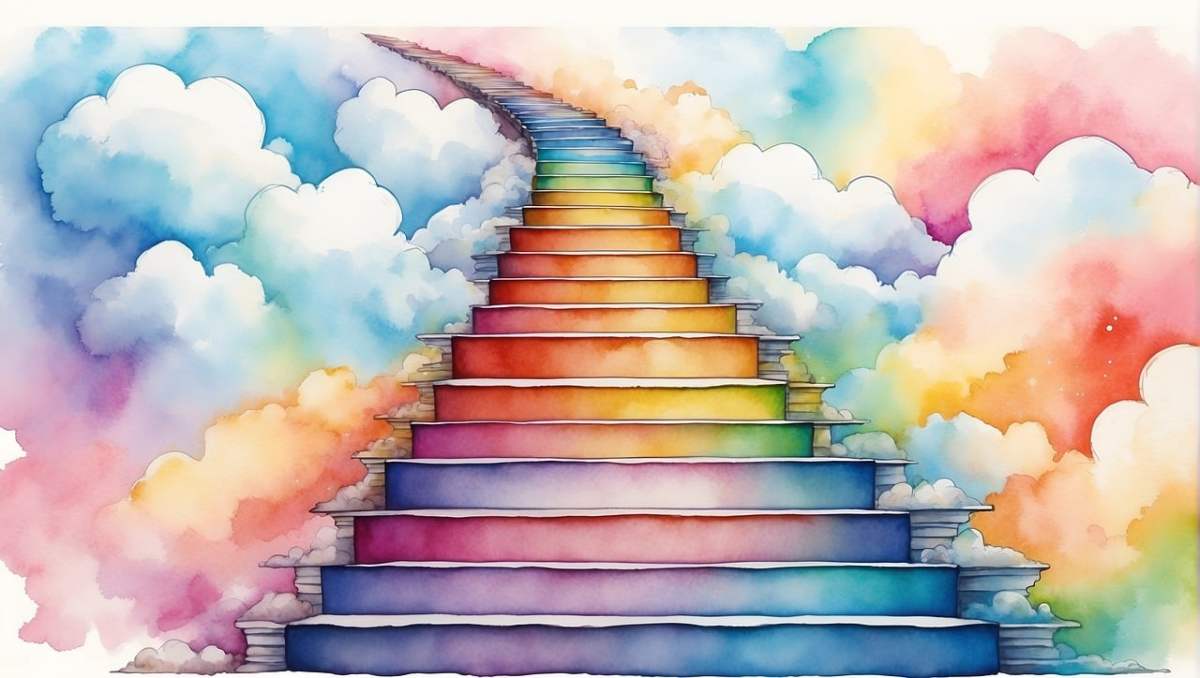
However, in recent decades the research of adult development and consciousness has revealed yet additional naturally occurring internal maps we can activate in order to grow our capacity for transcendence and happiness in life. These internal maps are known as levels accessed in a sequence from oldest to newest.
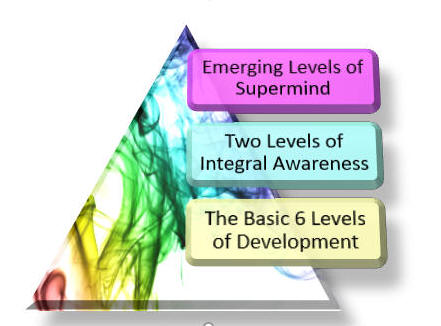
Transcending and including: We access these levels of thinking in an ordered sequence. They are built like a pyramid with each level providing a platform for the next level to evolve. Like Red Cross swimming lessons, we can’t skip levels but in the process of evolving, our understanding of the upper levels often precedes our personal activation of these levels. We can cognitively or mentally understand a higher level from our current activated one. However, we may have difficulty living from that place. On our journey of personal growth, our goal is to transcend our current level – taking the positive lessons of that level with us as we leave it behind and move into the next higher level.
Map of Integral Awareness…
Researchers from the Integral Theory community say that we transcend and include each level. When we have learned the lessons of our current level we may encounter experiences that begin the process of leaving it behind in order to activate the next level of conscious awareness.
Each level has been mapped back to its origin in the development of humanity with level 1 – called Archaic being the oldest at thousands of years old and Levels 7,8 and now 9 or 10 being the newest emerging only a few decades ago. How we think and process today is much different than just a generation ago. Each level comes with its own values, identity, perspectives and other characteristics.
Levels within Tiers – Levels one through six are referred to as Tier 1, and levels 7 and 8 are referred to as Tier 2. Research has also identified the recent emergence of what has been dubbed ‘supermind’ or Tier 3.
At Tier 1 each of the levels believes their perspectives and values are the correct ones and everyone else is wrong. By contrast people who have activated tier 2 within themselves are driven towards wholeness and consider each person to be at least partially right and holding a partial truth.
The value of learning about these maps is that it can help the activation process within us, support our inner growth and well-being and give us more perspective. We start tolerating the family discord with because of our inner ‘Aha!’ understanding. The more we access these maps within us, the more life begins to make sense, we are more compassionate, less judgmental, more generous and abundant. We come into harmony and resonance with and consequently experience what is ‘good, beautiful and true’(Ken Wilber) in our life.
While there are a number of researchers documenting these levels, my Life Repatterning system is adapted from the Integral Theory works of Ken Wilber and his supporting community. In my system we look at patterns of mindfulness that help us move through the levels. Using our present moment experiences we clear the left over patterns from unfinished levels of development that are holding us back.
We are then better able to transcend and include levels reaching for more options, more perspectives and ways of being that make us happy. For more information about how I incorporate integral understanding into repatterning visit my website… www.LightTravels.com . To learn more about integral theory visit the community website: www.IntegralLife.com
How does spiritual self-expression relate to love?
I believe awakening your spirituality begins with self-love—accepting yourself exactly as you are—having compassion for your weaknesses and celebrating your gifts—expressing the natural love of self with which you were born.
One of the highest spiritual expressions you can offer is loving others the way they are and the way they are not, and allowing yourself to be loved in return—this is unconditional love.
Feeling whole and complete within yourself, you can then love others from the overflow. You can expand your capacity to love by keeping your heart open no matter what—honoring yourself—expressing your needs and desires—and tapping into your uniqueness. Doing this will naturally spill over to those you love and can be an inspiration to those who love you. You can then encourage each other to be authentic and bring your unique self-expression to all your relationships and all areas of life.
One of the ways I connect to my inner divinity is to ride my bicycle through the park and sing, I Love Myself the Way I Am, written by Jai Josephs.
I love myself the way I am, there’s nothing I need to change.I’ll always be the perfect me, there’s nothing to rearrange. I’m beautiful and capable, of being the best me I can. And I love myself, just the way I am.
I love you the way you are, there’s nothing you need to do. When I feel the love inside, it’s easy to love you. Behind your fears, your rage and tears, I see your shining star. And I love you, just the way you are.
I love the world the way it is, ’cause I can clearly see. That all the things I judge are done, by people just like me. So ’til the birth of peace on earth, that only love can bring. I’ll help it grow, by loving everything.
I love myself the way I am, and I still want to grow. But change outside can only come, when deep inside I know. I’m beautiful and capable, of being the best me I can. And I love myself, just the way I am.
Accessing your self-expression—through exploring specific events in your life and the impact they had on your creativity, communication, and spirituality—can bring you more joy, peace of mind, happiness, fulfillment, and love.
Resonance Repatterning
This is where Resonance Repatterning® comes in. This method, developed by Chloe Faith Wordsworth, releases the resonance with not loving yourself and any generational beliefs that no longer serve you such as, ‘loving yourself means you’re self-centered’. It also allows you to heal wounds from past harmful experiences—along with any unconscious conclusions and patterns that ensued—in regard to your spirituality. It then allows you to align with your inner divinity and expand your capacity to love and be loved by keeping your heart open. You may want to consider going to the Repatterning Practitioners Association website and choosing a certified practitioner you feel guided to working with and give them a call. You’ll be amazed at the results.
May the wisdom inside you take you on a journey into your heart where your greatness abides. Now, that’s living a heart-centered, extraordinary life!
Lovingly Submitted, Victoria Benoit, M.C.
Healer, Speaker, Amazon #1 Bestselling Author, What Would Love Do Right Now? A Guide to Living an Extraordinary Life and Three Magical Words for a Magical Life.














 Repatterning Journal